

I’ve watched too many sales teams chase the wrong companies for months before realizing their targeting criteria stopped working sometime last year.
The ICP you built eighteen months ago was probably solid. You documented industries, company sizes, tech stacks, and geographies. You felt confident about who you were targeting.
Then the pipeline started filling with prospects that took forever to close, churned early, or never converted at all.
Here’s what happened: your market moved, but your targeting didn’t.
The Performance Gap Is Widening Fast
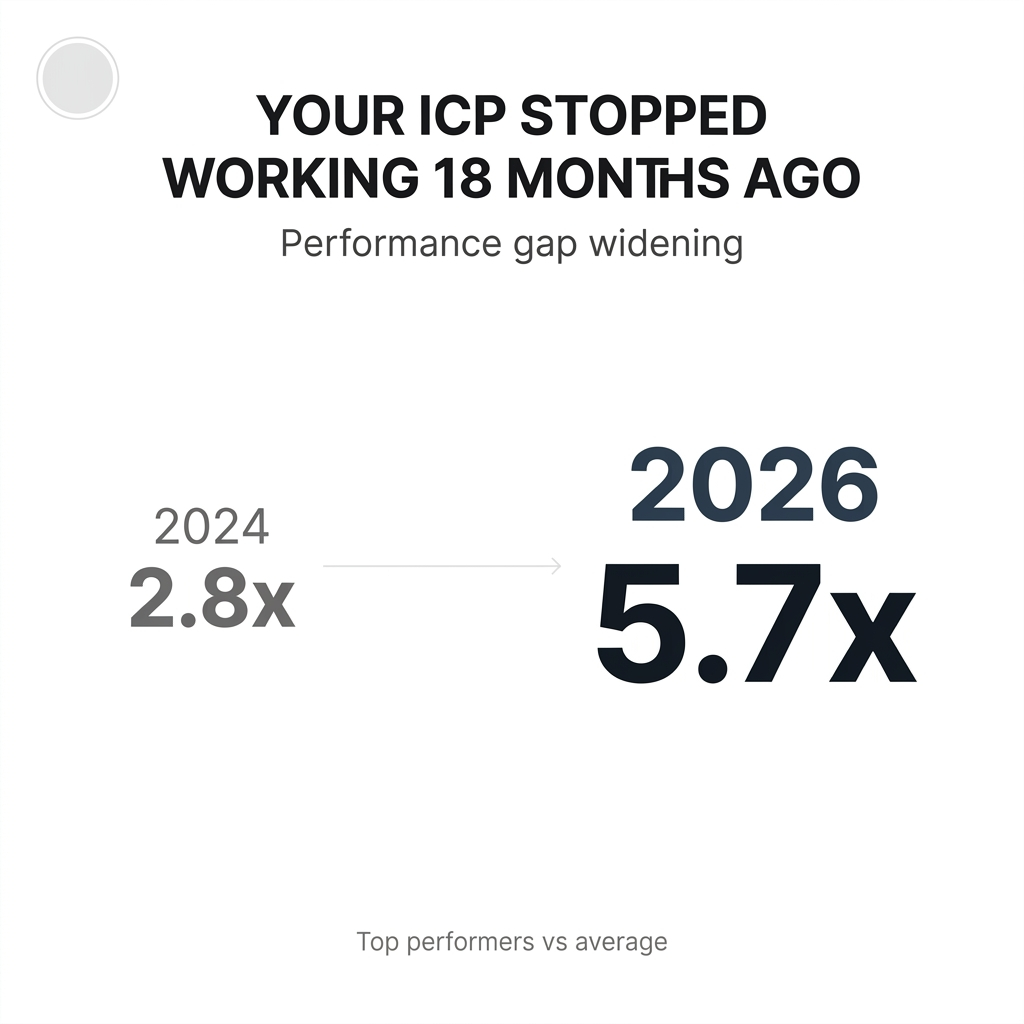
The companies crushing it in 2026 aren’t just slightly better at targeting. They’re operating in a different league.
In 2024, top performers generated about 2.8x more pipeline per sales dollar than average companies. In 2026, that gap has grown to 5.7x.
The difference? Speed of adaptation.
The best teams refresh their ICP quarterly. They use win/loss data, feedback from account executives, and insights from customer success to understand who’s converting, who’s churning, and why.
Most teams define their ICP once and assume it stays valid until something breaks.
Why Most ICPs Produce Mediocre Pipelines
You’re targeting companies that fit your criteria on paper. But in practice, most B2B sales ideal customer profile criteria are built on assumptions that feel logical but don’t actually predict whether a company will buy from you.
The common errors I see:
Confusing ICP with buyer persona. Your ICP defines the company. Your buyer persona defines the people inside it. Mixing these creates targeting chaos.
Over-relying on vanity metrics. Website traffic and social engagement feel good but don’t predict purchase intent.
Copy-pasting industry templates. What works for someone else’s business won’t work for yours. Your best customers have specific characteristics that generic frameworks miss.
Assuming the past defines the future. Building your ICP solely on your current client base ignores where you’re positioning the company next.
When your ICP criteria are too broad, everyone qualifies. Your pipeline fills up with companies at wildly different stages of readiness, with different problems, different budgets, and different timelines.
You can’t learn anything useful from a pipeline like that because there’s no consistent signal to analyze.
The Real Cost of Wrong Targeting
I’ve seen revenue leaders spend $5K–$10K chasing a company that looked perfect on paper but was never going to close.
You don’t just lose money when you market to the wrong people. You lose momentum.
The data confirms this. 60% of prospects are lost due to poor targeting. Another 44% disengage when messaging feels irrelevant.
Misaligned targeting creates longer decision-making processes, reduced customer retention, and higher support costs. Customers outside your ICP typically require more intensive support, which increases operational costs and reduces overall efficiency.
Your team burns out chasing deals that were never going to convert. Your best reps start questioning whether the product works. Your pipeline metrics look healthy until you realize nothing is moving.
How Buyer Behavior Changed While You Weren’t Looking
The buying process compressed and expanded at the same time.
Modern B2B buyers complete 70–80% of their decision journey before speaking to sales. They research independently, compare alternatives, and form opinions long before your rep enters the conversation.
Meanwhile, buying committees got bigger. Forrester’s 2026 research shows the typical buying decision now includes 13 internal stakeholders and 9 external influencers.
If you’re still targeting based on basic firmographics, you’re entering the race too late and talking to the wrong people.
Gartner reported in March 2026 that 67% of B2B buyers prefer a rep-free experience. Early targeting accuracy matters more because many buyers will size you up before speaking with a seller.
Translation: You get one shot to be relevant. If your outreach lands in the wrong inbox or addresses the wrong problem, you’re done.
The Diagnostic Process for Fixing Broken Targeting
Start with your bounce rate and unsubscribe metrics. A bounce rate above 55% or email unsubscribe rates over 2% signal that recipients don’t find your content relevant.
That’s a classic symptom of weak ICP alignment.
Next, analyze your win/loss data. Look at the deals you won in the last quarter. What do those companies have in common beyond industry and size?
Look for patterns in:
-
Growth stage and funding trajectory
-
Technology stack and integration requirements
-
Team structure and decision-making process
-
Pain point severity and urgency
-
Budget allocation and procurement cycles
Now do the same for deals you lost. Where did you waste time on companies that were never going to close?
The gap between these two groups reveals what your ICP should actually target.
Talk to your account executives. They know which prospects are easy to work with and which ones drain resources. They can tell you which objections come up repeatedly and which companies convert fastest.
Pull insights from customer success teams. They see who stays, who churns, and why. They know which customers require constant hand-holding and which ones scale independently.
When to Refresh Your ICP
If your company has a defined ideal customer and it hasn’t been updated in over a year, it’s time for a refresh.
An established enterprise company may only need an annual review. A newer startup should reassess quarterly to ensure marketing and sales strategies around the ICP stay aligned.
Markets change. Companies evolve. Your ICP should too.
Set a regular cadence to review and refresh based on new data. Make it part of your quarterly planning process, not something you do when the pipeline starts looking weak.
The sharper your ICP is, the more efficient and effective your outbound strategy becomes.
What Precision Targeting Actually Looks Like
When your ICP is dialed in, your outreach feels personal even when it’s automated.
Your messaging addresses specific problems that your target companies actually face. Your timing aligns with their budget cycles and decision-making windows. Your offers match their growth stage and resource constraints.
You stop chasing companies that will never close. You stop burning budget on campaigns that produce vanity metrics instead of revenue.
Your sales team spends time with prospects who are ready to buy, not educating people who aren’t even in-market yet.
That’s what happens when you build targeting criteria around actual buyer behavior instead of assumptions that felt right two years ago.
The Infrastructure That Makes This Sustainable
I built Higher Ranking because I needed a system that could identify the right prospects, reach them at the right time, and do it without burning out my team.
Automation handles the heavy lifting. It finds companies that match your refined ICP, monitors signals that indicate buying intent, and delivers personalized outreach at scale.
But technology alone misses the nuance. That’s why we combine automation with human expertise. Real people review targeting criteria, refine messaging, and adjust strategy based on what’s actually working.
The result is a pipeline full of prospects who are ready to have a conversation because you reached them when they needed what you’re offering.
Your ICP isn’t set in stone. It’s a living document that evolves as your market shifts, your product matures, and buyer behavior changes.
The teams winning in 2026 treat targeting as an ongoing diagnostic process. They refresh their criteria quarterly, analyze what’s working, and adjust before the pipeline starts showing cracks.
If your outreach isn’t landing the way it used to, your ICP probably needs an update.
Want to talk through your targeting strategy? I’m on speed dial for founders who need to fix their pipeline without guessing. Let’s figure out who you should actually be reaching.