

I’ve built $500K+ pipelines for SaaS founders and enterprise sales teams.
The pattern I see most often: teams automate based on what’s convenient, not what’s strategic.
They automate the wrong touchpoints. They leave money on the table. They damage relationships they spent months building.
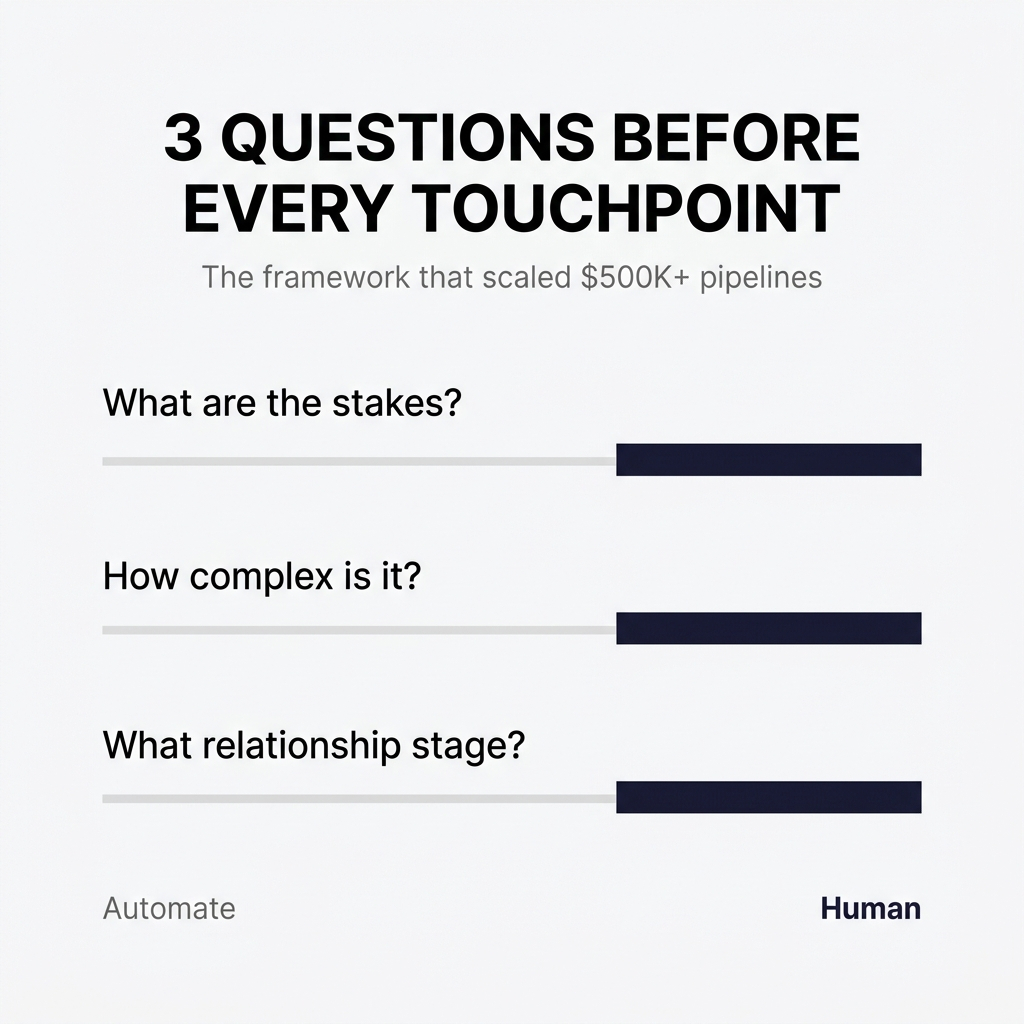
Here’s the framework I use before every touchpoint decision. Three questions. Simple. Repeatable. Keeps the pipeline moving without burning trust.
The Decision Tree: Stakes, Complexity, Relationship Stage
Every touchpoint in your pipeline sits somewhere on three axes.
Stakes: What happens if this goes wrong?
Complexity: How many variables need human judgment?
Relationship stage: Are we strangers, acquaintances, or partners?
Most automation fails because teams ignore one of these three. Usually stakes.
Question 1: What Happens If This Goes Wrong?
Low stakes = automate aggressively.
High stakes = human intervention required.
Low-stakes examples:
-
Initial outreach to cold prospects
-
Connection requests on LinkedIn
-
Follow-up reminders for inactive leads
-
Calendar booking confirmations
-
Content distribution to your list
If the worst outcome is radio silence, automate it.
High-stakes examples:
-
Pricing negotiations
-
Contract discussions
-
Objection handling during close
-
Renewal conversations with enterprise clients
-
Damage control after service issues
If the worst outcome is a lost deal or damaged relationship, keep a human in the loop.
The mistake I see: teams automate follow-ups after discovery calls. That’s a high-stakes moment. The prospect just spent 30 minutes with you. They shared problems. They’re evaluating whether you understand them.
An automated “thanks for your time” email reads like you weren’t paying attention.
Better approach: Automate the reminder to follow up. Write the email yourself.
Question 2: How Many Variables Need Human Judgment?
Complexity isn’t about difficulty. It’s about the number of inputs that change the output.
Low-complexity scenarios:
-
Same message to similar prospects
-
Standardized onboarding sequences
-
FAQ responses to common questions
-
Appointment scheduling based on availability
If the logic is “if X, then Y,” automation handles it.
High-complexity scenarios:
-
Customizing solutions based on discovery insights
-
Navigating multi-stakeholder buying committees
-
Adjusting pitch based on competitive landscape
-
Reading between the lines on objections
If the response depends on reading tone, interpreting context, or making judgment calls, you need a human.
Here’s where teams get burned: they automate nurture sequences without segmentation. They send the same content to a VP of Sales and a Marketing Coordinator. Different problems. Different authority. Different buying triggers.
The VP deletes it. The Coordinator forwards it to someone who might care. You just wasted both touchpoints.
Better approach: Automate the delivery. Segment the content based on role, industry, and behavior.
Question 3: What Stage Is This Relationship In?
Strangers tolerate automation. Partners expect personalization.
Early-stage (stranger to aware):
Automate heavily. They don’t know you yet. Your job is volume and consistency.
-
Cold outreach sequences
-
LinkedIn connection campaigns
-
Initial value-add content
-
Event invitations
At this stage, you’re building awareness. Automation scales that.
Mid-stage (aware to engaged):
Mix automation with human touchpoints. They’ve responded. They’ve shown interest. Now you’re building trust.
-
Automate: Meeting confirmations, resource delivery, calendar management
-
Human: Discovery call prep, post-call follow-up, objection handling
This is where most pipelines leak. You automate too much and the prospect feels like a number. You automate too little and you can’t handle volume.
Late-stage (engaged to partner):
Automate the logistics. Personalize everything else.
-
Automate: Contract generation, invoicing, onboarding task sequences
-
Human: Negotiation, implementation planning, strategic check-ins
Once someone is paying you, automation should free you up to deliver more value. Not replace the relationship.
The teams that scale without breaking trust understand this progression. They automate to create space for human judgment where it matters.
How I Apply This in Real Pipeline Work
When I built Higher Ranking’s lead gen system, I had to solve this exact problem.
We needed volume. We also needed quality relationships.
Here’s how the framework plays out in practice:
Automated:
-
Initial LinkedIn outreach (low stakes, low complexity, early stage)
-
Connection request follow-ups (low stakes, low complexity, early stage)
-
Content sharing with engaged prospects (low stakes, low complexity, mid-stage)
-
Meeting reminders and calendar management (low stakes, low complexity, all stages)
Human:
-
Responses to engaged prospects (medium stakes, medium complexity, mid-stage)
-
Discovery calls (high stakes, high complexity, mid-stage)
-
Custom proposals (high stakes, high complexity, late-stage)
-
Objection handling (high stakes, high complexity, all stages)
-
Strategic account management (high stakes, high complexity, late-stage)
The result: we generate 3.5x more leads annually while maintaining the personal touch that closes deals.
Automation does the heavy lifting. Humans do the thinking.
The Mistakes That Kill Pipelines
Mistake 1: Automating based on your convenience, not the prospect’s experience.
You automate because you’re busy. They disengage because they feel ignored.
Mistake 2: Treating all prospects the same.
A CEO and a junior employee need different approaches. Same automation = wasted opportunities.
Mistake 3: Automating the relationship-building moments.
Discovery calls, objection handling, negotiation—these are where trust gets built or broken. You can’t automate trust.
Mistake 4: Keeping humans in the loop for low-stakes tasks.
Manually sending calendar invites. Manually following up on cold outreach. This is where automation saves you hours every week.
Mistake 5: Not reviewing what’s automated.
Set it and forget it kills pipelines. Review your sequences monthly. What’s working? What’s getting ignored? Adjust.
What This Looks Like in Your Pipeline
Before you automate anything, run it through the three questions:
1. What happens if this goes wrong?
If the answer is “nothing serious,” automate it.
2. How many variables need human judgment?
If the answer is “more than two,” keep a human involved.
3. What stage is this relationship in?
Strangers = automate. Partners = personalize.
This framework scales. I’ve used it to build pipelines generating $500K+ in new business. It works for solo founders and enterprise sales teams.
The goal isn’t to automate everything. It’s to automate the right things so you have time for the moments that actually close deals.
The Bottom Line
Automation is a tool. Not a replacement.
The teams that win use it to scale their judgment, not replace it.
They automate the repetitive, low-stakes touchpoints. They stay human for the high-stakes moments where relationships get built.
Most teams automate based on what’s easy. The smart ones automate based on what’s strategic.
Stakes. Complexity. Relationship stage.
Three questions. Every touchpoint.
That’s the framework.